Margery Fish
Finding new authors

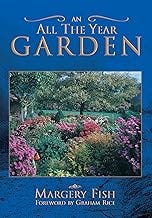
I was recently given a book written by a garden author that was completely unfamiliar to me. The author was Margery Fish and her book is called An All The Year Garden, published in 1958. As I started to read through it, I was struck by how much it reminded me of the writings of my favorite garden author Gertrude Jekyll. The styles were very much the same and I would imagine Mrs. Fish was influenced by Miss Jekyll as much as I have been.
I was intrigued enough to go online and find out what I could about Mrs. Fish. She was born in a section of London, England in 1892, just about the time Our Gertrude was starting her gardening career. Margery worked in the magazine trade before moving to newspapers where she served as a secretary to a succession of editors of the Daily Mail, the last being Walter Fish whom she married about three years after he retired in 1933. After a visit to Germany in 1937, Mr. Fish, being astute and certain war would soon affect England, moved his wife into the English countryside. They eventually found a permanent home in Somerset called East Lambrook Manor and Margery took up the hobby of gardening.
Here is where it gets interesting, at least to me. Margery had been a novice at gardening, but she knew enough that she wanted a cottage garden (all the rage at the time, thanks to Miss Jekyll) but one that relied heavily on native plants. She also wanted plants that would spread and self-seed, allowing for maximum impact with a minimum of cash outlay. And she wanted interest throughout the year.
Does this start to sound familiar? It did to me. These seem to be popular ideas in today’s gardening crowd. But Walter liked a more formal garden, with lots and lots of blooming flowers even if they only lasted a few days. In 1956, Margery wrote her first book We Made a Garden about the struggle of these two opposing gardeners. This book has been described as being as much about the difficulties of marriage as it is about the difficulties of starting a garden. So it wasn’t until Walter’s death in 1947 that Margery could implement her idea of a perfect garden. Margery begins to teach herself about plants, and she develops a correspondence with some of the most famous gardeners of the day. They exchange ideas and sometimes even rare plants. She becomes a dedicated collector of plants and opens her gardens for charitable events. In her spare time, Margery writes a garden column for a popular gardening magazine and then moves to writing books, starting with We Made a Garden. And it is now that she starts to have a dramatic effect on the style of British gardens.
Keep in mind that before World War II, only those with large country houses could afford the staff to maintain them. This was certainly true of gardens at those country houses. Gardens such as Hidcote Manor and Hampton Court had massive outdoor staff, with many of them specializing in a particular aspect of the garden. After the war, this type of garden became prohibitively expensive to maintain and only a very few lords and ladies, dukes and duchesses, or queens and princes were able to afford this type of care.
Mrs. Fish changed the way cottage gardens were viewed with her idea of a more manageable garden: one that could be easily tended by the homeowners on weekends or after work. Hers was a garden that included perennials as well as native plants and she did most of the work herself for many years, sandwiching her writings between her weedings. She enjoyed building her own stacked stone walls and laying her own paths. (Also sounds familiar! I do that, too!) And Margery fell in love with a group of plants that were not popular with the more established garden writers: hellebores. She loved them for their autumn-into-spring blooming period and their unusual green flowers. Margery also was fond of primroses, iris, penstemons, hardy cyclamen, heuchera, and hardy geraniums and their uses in the year-round garden. And of course, we find these same plants - but different varieties - in our coastal gardens today.
Margery died in 1969, and East Lambrook has passed to several owners since then. The current owners regularly open the garden to the public and occasionally hold horticulture classes there.
What a kind gift this was from my friend. Little did she know I would find a new garden author in which I have so much in common. I can’t wait to track down a few of Margery’s other books after I finish reading this one.
(You can find this book for a reasonable price (used) on Thriftbooks.com or in a Kindle version on Amazon.)