Seeing Ghosts

July in the garden is more one of maintenance and not planting. But I find myself wandering around the garden, thinking about what needs to change next spring. And I try to jot down notes once inside so I can add the new ideas to my journal.
I find myself enjoying weeding and deadheading in mid-to-late summer. I try to get out to a different area once a day so by the end of the week, I am in good shape. Even an hour once a day helps to keep the weeds down. And deadheading is always fun as I know it spurs on new blooms.
But as I was deadheading my daisies the other day, I noticed a bee in distress on the petals. Now, I have tried my best to make my garden pollinator friendly: no insecticides, planting a variety of flowering annuals and perennials for a wide timeline for blooming, and even putting out little water sources during our dry summer. So I was rather upset to find the poor bee struggling.
Upon further inspection, he seemed to be attached to a tiny white, ghost-like spider. So, angered, I sprang to action, killing the spider and trying very gentle to free the bee. I was only partly successful because – although I managed to get him free - he was so stressed, he eventually died. I take any bee death personally, so was determined to make sure no other spiders were weaving their nefarious traps. And I did find a larger white spider, hiding under a different daisy petal. I dispatched that spider as well before she did any harm.
Time for some research. Going first to the internet, I determined my invaders were the goldenrod crab spiders. They are called “crab” spiders because of their ability to walk sideways as well as forward and backward. They do have large, white, egg-shaped abdomens and white legs, making them almost invisible among daisies and other white flowers.
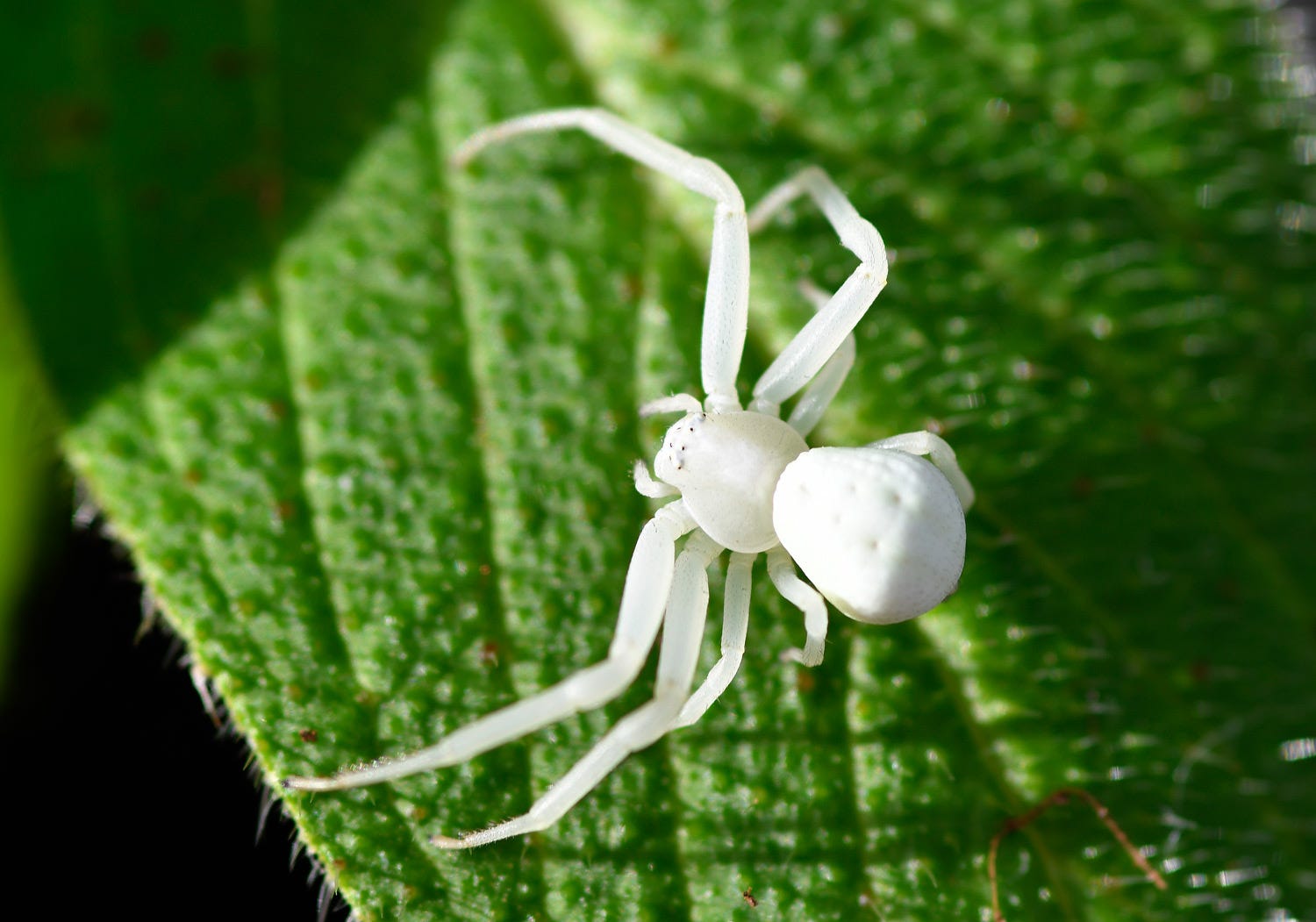
According to the Oregon State University website, the goldenrod crab spider can change color to match the flower they are using as bait. In this way, they ambush unsuspecting bees and pollinators. For example, they are yellow when hunting for yellow-faced bees that are so common in the PNW. The spider will sit, camouflaged, in the center of a flower and wait. When a bee approaches, the spider will wrap its legs around the bee and inject a neurotoxin into the bee with her fangs. After reading that, I knew there was nothing I could have done to save my bee. He was doomed.
Goldenrod crab spiders develop the ability to change color as they age to blend in with their surroundings, too. Male crab spiders can be very colorful as they camouflage themselves. Females are larger and a very bright white with tan stripes down their sides. The females live with their egg sacs in order to protect them. One of the males’ favorite hosts is goldenrod (thus the name), but they also like daisies and milkweed as well. They are very common in gardens across North America. They are harmless to humans.
The spiders take about six days to change color from yellow to white, but much longer (10 to 25 days) to change from white to yellow. This is because the process for producing the yellow pigment takes longer than the process to excrete it.
But their primary food source is pollinating insects like butterflies and bees, which makes it important to watch for a crab spider infestation. In my case, I hadn’t noticed anything until I saw the captured bee, but just by looking under daisy petals, I found several more easily.
However, there is a school of thought that having predators among the pollinator populations helps the prey to develop traits over several generations that allows them to better defend themselves. Traits like better eyesight and faster reflexes. Survival of the species, as it were. And the crab spiders also feed on less desirable insects like grasshoppers and katydids which can affect crops.
So do we protect our bees and butterflies or protect our spiders? A question individual gardeners need to decide for themselves. For now, I think I will strive to protect the bees and let the crab spiders fend for themselves.